Pima Indians Diabetes classifier
Inspiration
Diabetes is a major global health concern influenced by a combination of genetic, environmental, and lifestyle factors. Pima Indian women experience disproportionately high rates of diabetes, which inspired us to investigate whether health measurements could be used to predict diabetes within this population.
What It Does
This project analyzes the Pima Indians Diabetes dataset and builds a machine-learning model that classifies whether a patient is likely to have diabetes.
The model uses health-related features such as glucose level, blood pressure, skin thickness, insulin level, BMI, and age. It also includes visualizations and performance metrics to explain the model’s results and limitations.
How We Built It
We completed the project in R using Jupyter Notebook. First, we cleaned the dataset, converted the diabetes outcome into a categorical variable, and divided the data into training and testing sets.
We then standardized the predictor variables and trained a k-nearest neighbors classification model using the tidymodels framework. To select an appropriate number of neighbors, we tested multiple values of k using five-fold cross-validation and visualized their estimated accuracy.
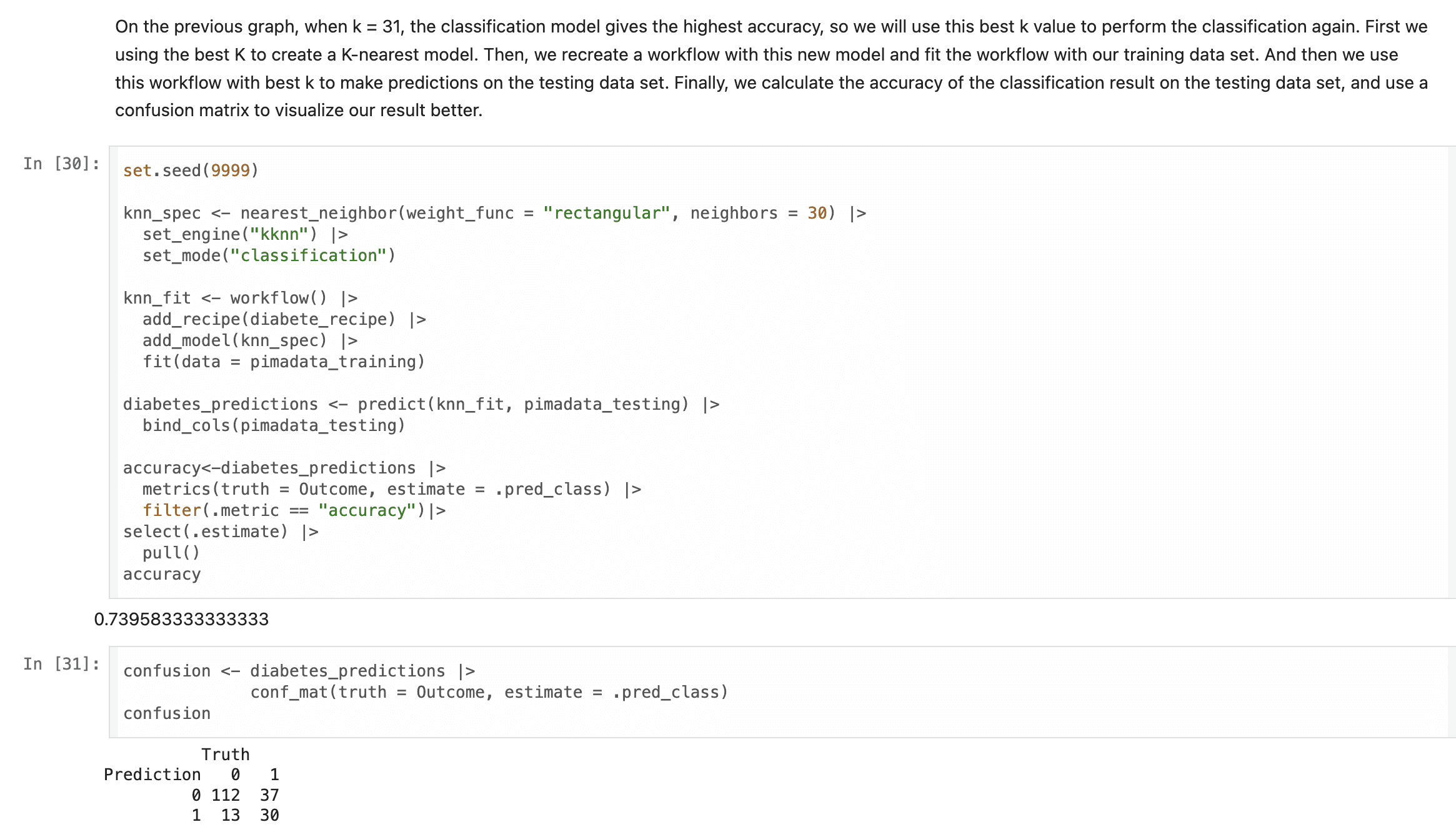
Finally, we evaluated the model on unseen testing data using accuracy, precision, recall, and a confusion matrix. The final model achieved approximately 74% accuracy, but its low recall demonstrated that accuracy alone is insufficient—especially in a health-related application where missed positive cases can have serious consequences.
Built With
R, Jupyter Notebook, tidyverse, tidymodels, ggplot2, kknn, k-nearest neighbors, five-fold cross-validation, and the Pima Indians Diabetes dataset.
This project is an educational data-science analysis and should not be used as a medical diagnostic tool.
Inspiration
As (broke) college students we are always trying to find the best deals for food near us. But with so many options it can be overwhelming knowing where to look. Go Grocer is here to help!
What it does
Go Grocer takes an image of the food item you are looking for, runs it through the search algorithm then gives you the closest and cheapest grocery store near you.
How we built it
First we created mockups and designed a simple UI using Figma. Then, we used React Native, Javascript and Typescript to build the frontend and backend. We leveraged the power of the Gemini API for image analysis and for sorting the results while, the Google shopping and Google places API provides the grocery store data.
Built With
gemini, google-places ,google-shopping, javascript, json, ngrok, react-native, typescript